
How Mad Cow Disease Is Transmitted

So, You're Having Beef for Dinner, Eh?
Ever had one of those moments where you're sitting down to a juicy steak, and suddenly, that scene from "Silence of the Lambs" pops into your head? You know the one - "I do wish we could chat longer, but... I'm having an old friend for dinner." Cue the chills, right? Well, let's talk about that old friend, or rather, the disease that made it famous - Mad Cow Disease, or Bovine Spongiform Encephalopathy (BSE) to give it its Sunday best name.
Where Did It All Begin?
Picture this: it's the 1980s in the UK. Farmers are struggling with a mysterious disease that's turning their cattle into zombie-like creatures, stumbling around with tremors and trembles. It's like something out of a horror movie, and it's spreading like wildfire. This, my friends, was the birth of our infamous 'Mad Cow' problem.
Now, you might be thinking, "Okay, that's cows, not humans. Why should I care?" Well, remember that old saying, "You are what you eat"? Turns out, that goes for cows too. And when they're eating something they shouldn't, like other cows, bad things can happen. Like, really bad things.
Must Read
So, How Does This Thing Spread?
Enter the Prion
Mad Cow Disease is caused by something called a prion. Now, don't worry, I had to look that up too. Prions are basically proteins that can misfold and turn other proteins into their misfolded selves. It's like a bad dance move that spreads through a crowd, except instead of the Macarena, it's brain damage.
These misfolded proteins build up in the brain and cause holes, like a sponge. Hence the 'spongiform' part of the name. And once that happens, there's no going back. It's progressive, meaning it gets worse over time, and ultimately, it's fatal.
From Cows to Humans
Now, here's where it gets a bit grim. Remember how I said cows were eating other cows? Well, that's because in the 1980s, farmers were using meat and bone meal from infected cows to feed their healthy ones. It was a cost-effective way to recycle nutrients, but it turned out to be a recipe for disaster.
You see, these prions are tough cookies. They can survive cooking, freezing, and even stomach acid. So, when infected meat was fed to healthy cows, the prions made their way into the food chain. And when humans started eating infected beef, they too were at risk of developing a human form of the disease, known as variant Creutzfeldt-Jakob disease (vCJD).
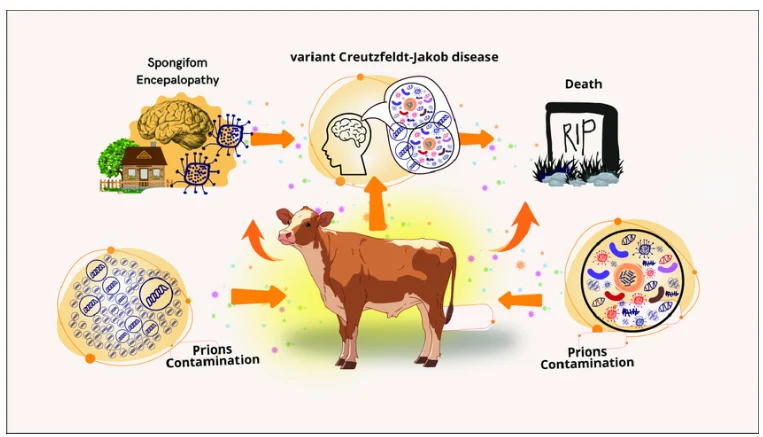
But here's the thing, while cows can get sick from eating infected meat, humans can't. Our stomach acid is strong enough to kill the prions before they can do any damage. The problem is, some of the parts we eat, like brains and spinal cord, don't get exposed to that acid. And that's where the risk comes in.
So, Should We All Be Wearing Tinfoil Hats?
Alright, let's calm down a bit. While Mad Cow Disease was a serious issue in the 1980s and 1990s, it's not something we need to lose sleep over today. Here's why:
- Feed Ban: In 1988, the UK introduced a ban on feeding meat and bone meal to cows. This stopped the spread of the disease in its tracks.
- Testing: Cows are now tested for BSE before they're slaughtered. Any positive results mean the meat doesn't make it to our plates.
- Cooking: As I mentioned earlier, prions can't survive high heat. So, cooking your meat well done is a simple way to kill any potential prions.
So, while Mad Cow Disease is still out there, it's no longer the threat it once was. But that doesn't mean we should forget about it. Understanding how it spread and how we stopped it can help us prepare for future health threats.
And hey, it's always good to know what we're eating, right? So, the next time you're tucking into a juicy steak, you can do so with the knowledge that you're not just enjoying a delicious meal, but also celebrating a victory over one of the weirdest and most terrifying diseases out there.
Just... maybe don't think too hard about the 'old friend' part.